Russian manicure vs. regular manicure: what's actually different
If you have ever paused on a close-up of impossibly clean cuticles and wondered how it was done, you were probably looking at a Russian manicure. The name describes a technique, not a color or a shape, and it has become one of the most requested nail services in Chicago for one simple reason: it lasts.
How a regular manicure works
A classic salon manicure starts with a soak. Warm water softens the skin, the cuticle is pushed back and loose skin is trimmed with nippers. Polish or gel then goes on, usually leaving a small gap between the color and the skin so the product doesn't flood the cuticle.
It is quick and pleasant, but it has limits. Softened, swollen skin makes it hard to see exactly where the cuticle ends, and the thin, nearly invisible layer of dead tissue stuck to the nail plate often stays behind. Gel applied over that layer lifts sooner, and the gap at the base becomes obvious as the nail grows.
What makes the Russian manicure different
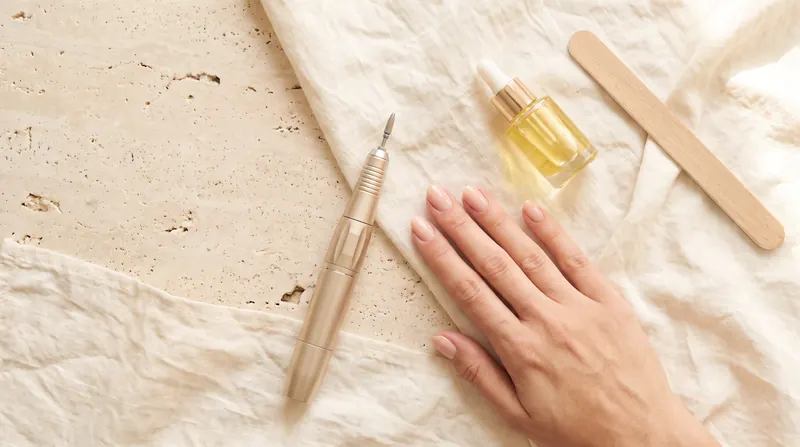
The Russian manicure is performed dry, with an electric file and a set of fine, specialized bits. Your technician gently lifts the cuticle, removes the non-living tissue from the nail plate and refines the sidewalls, finishing with nippers only where they are truly needed.
- No soaking. Skin keeps its true shape, so the technician can work precisely.
- A completely clean nail plate. Gel bonds evenly instead of sitting on leftover tissue.
- Color close to the cuticle. Gel can be applied almost flush to the skin, which gives the manicure its crisp look.
Why it lasts longer
Adhesion is everything with gel. A clean, properly prepped nail plate has fewer weak points at the base and sides, which is where lifting usually starts. And because color begins right at the cuticle line, new growth appears gradually rather than as a sharp band of bare nail. Most of our clients comfortably wear a Russian gel manicure for three to four weeks.
Is it safe?
In trained hands, yes. The e-file removes only dead tissue; living skin is never cut. What matters is skill and hygiene: bits should be sterilized between clients, files and buffers should be single-use, and speed should always be adjusted to your comfort. If your skin is broken, inflamed or infected, the service should wait until it has healed.
If you are nervous about the e-file, say so. A good technician will explain each step as they go.
Who is it for?
Almost everyone. It is especially good if your gel usually lifts in the first week, if your cuticles are overgrown or uneven, or if you want a manicure that still looks tidy when life gets busy. If your natural nails are medium or long, ask about structured gel, which adds a thin reinforcing layer for extra strength.
How often should you book?
Every three to four weeks keeps both the gel and the cuticle area in top condition. Waiting longer means more regrowth to balance and a higher chance of the gel catching and lifting at the free edge.
Curious to try it? Book a Russian manicure with Sabina, Fidan or Lisa, or see the full price list first.
Russian manicure at 11 Beauty Space